
Commitment to serve joyfully defines church

(This story first appeared in UMNews.org. The next webinar in this series is Lead Courageously, on March 21, 2026.)
When the Rev. Shandon Klein thinks of United Methodists in mission, she immediately points to the small, rural congregations she serves in North Dakota and Minnesota that are always willing to share the bounty of their harvests.
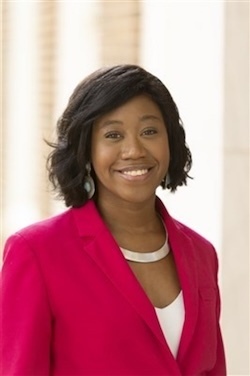
Rev. Shandon Klein, serving Fairmount, ND, UMC.
One congregation — Breckenridge United Methodist Church with an average attendance of 30 to 40 people — even provided more than 1,000 pounds of food and other items to the local food pantry over the past year.
Klein also thinks of her fellow United Methodists in Minneapolis. Along with fellow Minnesotans, they are providing groceries for neighbors fearful of leaving their homes, legal representation for those detained and space to breathe amid a continuing siege by federal immigration enforcement.
“They are working together to ensure our immigrant neighbors not only know their rights here in this country legally,” she said, “but also know their right to be loved and valued for who they are as human beings.”
Such varied forms of mission are just the tip of the iceberg of how United Methodists “serve joyfully” around the globe.
Klein was among United Methodist leaders from three continents who led a Feb. 21 webinar exploring how a Wesleyan understanding of mission undergirds the denomination’s vision to “serve joyfully.”
The hour-and-a-half webinar is the second of three discussing the denomination’s new vision statement in preparation for the Leadership Gathering that the United Methodist Council of Bishops has planned for Oct. 20-24 in Calgary in Alberta, Canada.
A January webinar focused on the vision’s first component, “love boldly.” That webinar is now available in recording alongside a discussion guide from Discipleship Ministries.
The next webinar, featuring different panelists, is scheduled for March 21. It will focus on the Wesleyan teachings that inform the vision statement’s final component, to “lead courageously.”
Klein is a provisional elder serving in the Minnesota Conference and a doctoral candidate in religious ethics at United Methodist-related Southern Methodist University in Dallas.
Joining her on the panel were the Rev. Mark W. Lewis, an ordained elder and missiologist from the U.S. serving in Denmark, and Darlene Marquez-Caramanzana, a deaconess based in the Philippines and the Asia and Pacific liaison for the United Methodist Board of Global Ministries. Moderating the conversation was the Rev. April Casperson, an ordained deacon and director of enrollment management at United Methodist-related Methodist Theological School in Ohio.
The panelists’ varied titles are an indication of the many ways United Methodists can “serve joyfully,” whether as clergy or laity.
Lewis explained that Christian mission is central to the calling and identity of the church.
“In mission theology, we talk about the Missio Dei, which is the mission of God, and how we understand that, is God’s calling for all of us to be reaching out beyond our own boundaries and to be connected with those beyond ourselves,” Lewis said.
The starting point of mission, he said, is The Great Commission in Matthew 28:19-20 when Christ instructs the disciples: “Go therefore and make disciples of all nations, baptizing them in the name of the Father and of the Son and of the Holy Spirit and teaching them to obey everything that I have commanded you.”
Those verses are the basis of The United Methodist Church’s longtime mission statement: “The mission of The United Methodist Church is to make disciples of Jesus Christ for the transformation of the world.”
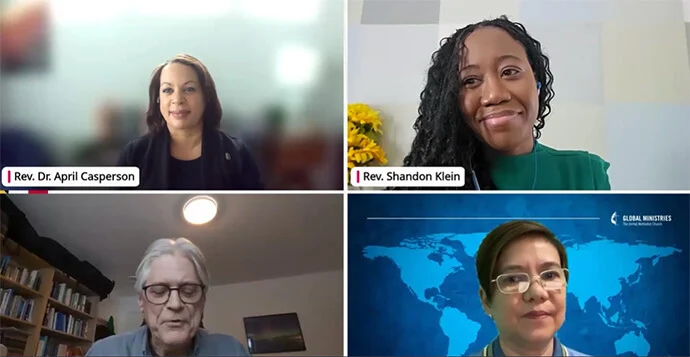
Serve Joyfully webinar panelists
The denomination’s mission statement outlines its task, while the vision statement, unveiled last year, outlines what the denomination aspires to become.
Lewis acknowledged that Christians have misused The Great Commission to do great harm through conquests, crusades, and colonialism — sins he described as “antithetical to the Spirit of Christ and what the Holy Spirit is leading us to do.”
The Great Commission, he said, must always be paired with the Great Commandment to love God “with all your heart and with all your soul and with all your mind” and “love your neighbor as yourself.’
Lewis added that Jesus is explicit that the word “neighbor” doesn’t just apply to people who look like us or live nearby. “‘Neighbor’ means the entire world,” he said.
John Wesley, Methodism’s founder, had that conception of neighbor. He famously wrote: “I look upon all the world as my parish.”
He was also an exemplar of what Lewis called “glocal” thinking, combining consideration for both the global and local in his ministry. His work included establishing London’s first free health clinic and supporting the abolition of slavery.
Perhaps it’s no surprise that many still-existing civic organizations and charities trace their roots back to members of the Wesleyan tradition, including Goodwill Industries, the Society of St. Andrew, and the Salvation Army, a denomination that grew out of Methodist mission.
Key to the spread of the Wesleyan movement was Wesley’s cultivation of small groups, including band and class meetings.
“Those Wesleyan bands and class meetings were so formative for the early Methodist Church,” said Klein, who has been in a band meeting herself for the past eight years.
“One of the main things was actually learning how to be in relationship with one another,” she said. “You asked those deep questions like, ‘How is it with your soul?’ How are you really? You started to learn that people you were interacting with may have been dealing with different things.”
Those kinds of strong relationships proved key to taking Methodism out of building walls and into the world — especially where there is hardship and injustice.
Marquez-Caramanzana, the deaconess, described her first exposure to mission when, as a 12-year-old, she joined members of her church in traveling to poor communities around metro Manila to bring snacks and teach extension classes for children. That often meant going to flood-prone areas rarely visited by politicians except at election time.
“We would sing, play, sing songs, and pray,” Marquez-Caramanzana said. “We would eat together, as we usually bring simple snacks so that we can eat with the children after the class. But one thing remains in my mind, and that is the beautiful smiles and warm welcome the children and their parents would always meet us with whenever we arrived in the community.”
That experience also helped shape her sense of call to become a deaconess.
Deaconesses and home missioners are lay people who are called by God to be in a lifetime relationship in The United Methodist Church for engagement with a full-time vocation in ministries of love, justice, and service.
“Our reason for being a church is not within the four solid walls of our beautiful churches or cathedrals,” Marquez-Caramanzana said. “To be a church in mission is to live within communities and let the light of God shine through our engagement and encounters with people. These encounters had been life-changing for me, and I believe that our mission work (is) also life-changing for others.”
The webinar’s discussion also touched on the denomination’s colonial heritage, systems of justice, and Wesley’s call to both personal and social holiness.
At the end, the panelists also faced the question from a webinar viewer: “Where are we now, and how do we get to where we want to be?”
Both Marquez-Caramanzana and Klein answered by referencing another familiar Wesleyan phrase, observing that The United Methodist Church still is “going on to perfection.”
“We’re a global, international church, right?” Klein said. “So, it’s going to be different for different places. We are all battling different systems.”
One of the reasons the denomination is holding the Leadership Gathering, she said, is to look at the denomination’s new structure of regionalization and work to engage in mission “in decolonial ways.”
“We hopefully are on our way towards that as we continue to interrogate ourselves to ensure that we’re creating those just systems ... but also confronting those harmful systems when we see them, whether it’s within our own governments or within our churches or within our local areas.”
Hahn is assistant news editor for UM News. Contact her at (615) 742-5470 or newsdesk@umcom.org. To read more United Methodist news, subscribe to the free UM News Digest.