
Walking in the Footsteps of American Methodism

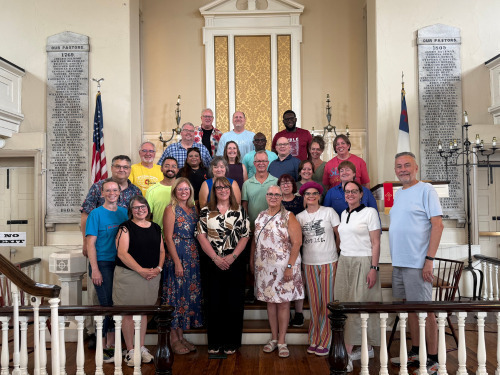
Participants gathered at Historic St. George's UMC in Philadelphia, PA.
For six days in late July, clergy from the Dakotas and Minnesota Annual Conferences stepped out of their usual routines and into the history of American Methodism.
From July 26-31, participants traveled together through New York City, Philadelphia, Delaware, and Baltimore as part of the American Methodist Pilgrimage, a partnership with the General Commission on Archives and History (GCAH). The six-day journey invited participants to “walk in the steps of Bishop Francis Asbury and other early Methodist leaders” while discovering the places where American Methodism took root.
The pilgrimage included stops at historic Methodist sites including John Street United Methodist Church in New York City, Historic St. George’s United Methodist Church and Mother Bethel African Methodist Episcopal Church in Philadelphia, Barratt’s Chapel in Delaware, Old Otterbein, Sharp Street Memorial, and Lovely Lane United Methodist Churches in Baltimore, and other sites connected to the history of the denomination.
But for those who participated, the trip was about more than visiting historic buildings and learning names and dates. It was an opportunity to experience Methodist history in a new way, reflect on the church’s past, and consider what that history means for its future.
Rev. Ryan Mutzenberger of Fargo First United Methodist Church, North Dakota, was interested in visiting places he had previously only read about and studied in seminary. “When listening to those who presented the stories of each historical place, I was reminded of the why, the passion, and the uniqueness of what makes us United Methodists today,” Mutzenberger said. “This wasn't only a history tour; it was a catalyst of a movement that changed the world more than 250 years ago and is still changing the world today!”
“As I was going on this pilgrimage, the words of historian David McCullough kept ringing in my ears, ‘It is not until you walk in the places they walked, see the things they saw, do you really begin to understand what they did and how they did it,’” said Rev. Rob Moorlach of the Conde-Groton-Britton churches in South Dakota.
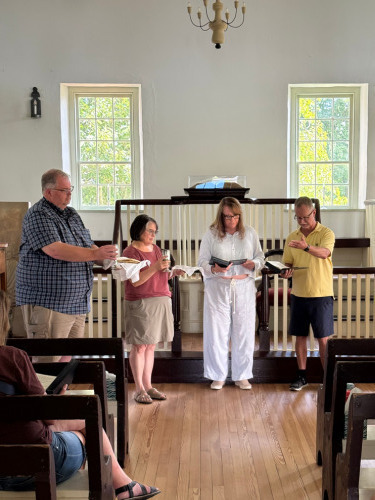
Bishop Lanette Plambeck served communion in Barratt's Chapel in Delaware.
Throughout the week, participants walked through Lower Manhattan, traveled by bus from New York City to Philadelphia, explored the history of Methodism at the nation’s founding, visited Independence Hall, and gathered for communion at Barratt’s Chapel. The group also explored African American Methodist history, including a walk to Mother Bethel African Methodist Episcopal Church, before continuing on to historic Methodist sites in Baltimore.
For Rev. Dawn Houser of Aitkin United Methodist Church, Minnesota, the pilgrimage brought history to life through storytelling while also offering a deeply personal connection between her Native American spirituality and her Wesleyan faith.
“As an Anishinaabe person and pastor in The United Methodist Church, I continue to question why I stay in The United Methodist Church. This pilgrimage reminded me why I stay,” Houser said. “I fell back in love with the Wesleyan spirit. That same Wesleyan spirit is in my DNA.”
For others, the pilgrimage offered a chance to connect their own Methodist journeys with the people and places that came before them.
“This experience was incredibly affirming for me,” said Rev. Leslie Zeek from Detroit Lakes United Methodist Church, Minnesota. “As someone new to the Minnesota Annual Conference, it was wonderful to get to know so many people and make new friends.”
Zeek, who grew up on the East Coast, said walking in the footsteps of early Methodist leaders helped connect her own history with the heritage of The United Methodist Church.
“To walk in the steps of pioneers like Francis Asbury and Richard Allen, to listen to their stories in more depth, connected me to a heritage I have claimed for the last two decades,” she said. “I was truly blessed to be a part of this group, considering how our past can lead us into our future as we continue to move on in Christian perfection.”
The opportunity to travel alongside colleagues from both conferences was another meaningful part of the experience.
Rev. Max Richter of Good Samaritan United Methodist Church in Edina, Minnesota, has roots in the Dakotas Conference through youth and camping ministry and has called Minnesota home since the early 1990s.
“To be with this group of peers was like going home and looking to the future of our heritage all at once,” Richter said, “This trip gave me time to reflect on the work of restoration and regeneration happening and yet to come in my local congregation and also for the shared ministries of both Conferences.”
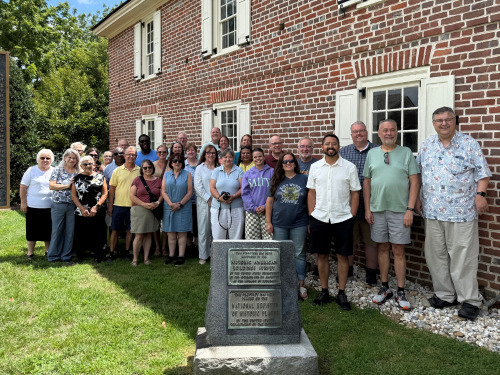
The group stopped to take a picture outside of Barratt's Chapel.
The American Methodist Pilgrimage offered participants a chance to look backward while also looking forward. By experiencing the places where early Methodists worshiped, traveled, preached, and built community, participants were reminded that the story of Methodism is not simply a story preserved in books and archives. It is a living heritage that continues to shape the church today.
Bishop Lanette Plambeck, resident Bishop of the Dakotas Minnesota Episcopal Area, reflected on the pilgrimage as an opportunity to connect the church’s history with its ongoing ministry and formation.
“By walking the places where the American Methodist movement took root, we were invited to remember with gratitude, return to the heart of our Wesleyan identity, and respond anew to where the Holy Spirit is leading us,” Bishop Lanette said. “As we prioritize formation in the Wesleyan tradition and deepen our commitment to clergy well-being, it was beautiful to experience both come to life through pilgrimage, learning, worship, and community in New York, Philadelphia, Delaware, and Baltimore. I am already looking forward to journeying with a second group.”
For the clergy who made the journey, walking those historic streets and gathering in those sacred spaces offered a renewed appreciation for where the church has come from, and an opportunity to consider where God may be leading it next.
The past was not simply something they studied on this pilgrimage. They walked through it, listened to its stories, and carried those stories with them as they returned home.
The General Commission on Archives and History, the architect of the pilgrimage, plans to make the American Methodist Pilgrimage an annual opportunity, inviting others across the connection to walk in the footsteps of those who helped shape our Methodist heritage and discover how that history continues to inspire the church today.