
Shared Ministry, Shared Mission: a new appointment partnership

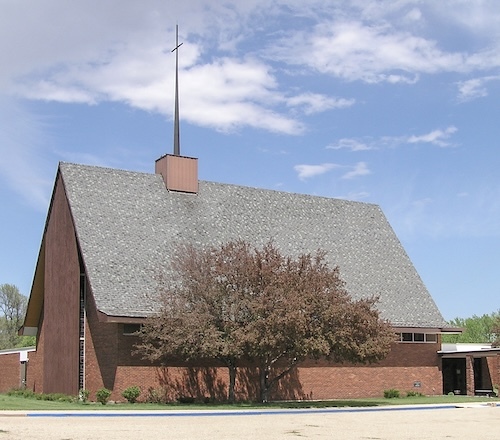
Clark United Methodist Church.
When congregations face limited financial or human resources, creativity and collaboration can open new doors for ministry. A new appointment partnership between Clark United Methodist Church and Watertown First United Methodist Church is one such example—showing how churches across the Dakotas Conference are finding faithful, flexible ways to continue vital ministry.
As the 2025 appointment season progressed, the United Methodist Church in Clark, South Dakota, opened up. As part of the process, the superintendent met with the pastor-parish relations committee to discuss the congregation's missional needs. These conversations also include determining the church's capacity to support a full-time or less-than-full-time pastor. Like many churches, in recent history, Clark UMC had been a part of a two-point charge – sharing a pastor with another church. Their pastor had also provided oversight, sacramental services, and emergency pastoral care for smaller churches nearby, using small stipends to offset the church's overall pastoral compensation package.
As the Cabinet began to consider Clark UMC's needs and those of other churches in the area, the possibility of a new partnership emerged.
“The Watertown First UMC associate pastor appointment came open at the same time,” recalled Rev. Kris Mutzenberger, conference superintendent. With a limited number of available pastors for full-time appointments, it can be challenging to fill associate roles. In this case, the challenge became an opportunity to try something new.

Pastor Kim Hastings
In July 2025, Pastor Kim Hastings was appointed to serve as associate pastor at 50% for both Clark UMC and Watertown First UMC. In practice, that means Kim spends two days a week in each community. She preaches and leads worship in Clark 3-4 Sundays a month and once a month in Watertown. Like most ministry settings, the schedule includes flexibility.
“We’re just trying to balance everything and learning as we all go,” Kim shared. “I love the grace and the permission that both congregations have wholeheartedly given me. They've both been just fantastic.”
In addition to her appointments with Clark and Watertown, Kim provides pastoral supervision, worship leadership, and communion at least once a month at the United Methodist Churches in Frankfort and Henry—another example of how shared leadership can support multiple communities of faith.
Different Churches, Shared Commitment
At Watertown First UMC, Kim serves primarily in discipleship and care. “They already do a very good job being lay-led in care,” Kim said. “A lot of what I’ve been doing is giving an overarching umbrella—helping fill gaps, making pastoral visits, and asking questions like, ‘Who have we been missing, and how can we bring them into the fold?’”
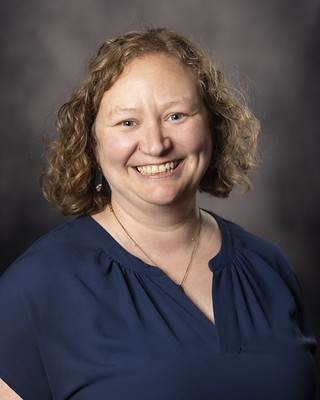
Rev. Sara McManus.
Watertown Senior Pastor Sara McManus said the congregation was open—and even excited—when the idea of a shared appointment was first introduced.
“Since we had been told that we might not have an associate at all, my folks were excited to try this,” Sara said.
She believes the partnership works because of strong relationships and a shared sense of purpose. “Our communities and people are connected, and we are able to see the importance of each other’s work. Kim is a joy to work with, and our congregation has a lot of respect for her.”
Learning, Adapting, and Trusting God
For Kim, serving in multiple contexts has been both challenging and deeply meaningful. “I’m learning a lot about myself and a lot about different churches and how they function,” she said. “It’s so cool to see people’s faith—the people who are stable and firm in their faith, whether in a larger church or a small town.”
Switching between preaching contexts has required intentionality. In Clark, Kim is with the congregation three to four Sundays a month, allowing space for sermon series focused on relationship-building. In Watertown, she is “a piece of the puzzle” alongside the senior pastor and youth pastor.
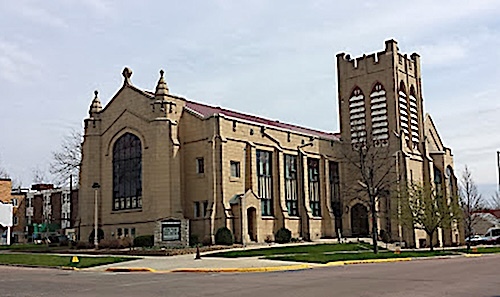
Watertown First UMC
“I told my SPR chair in Clark that I’m just a professional guinea pig at this point—and I’m OK with it,” Kim said with a laugh.
Local Leadership and Lay Vitality
At Clark UMC, lay leader Dala Albright says the arrangement has been a blessing.
“I think it’s going great. Pastor Kim is there any time we need her,” Dala said. While the churches have experimented with new ways of doing things—some more successful than others—Dala sees the partnership as a practical and hopeful solution. “We thought it was a great option because we couldn’t afford a pastor on our own, and because we have a parsonage, she is able to be in Clark, which really helps.”
Kim has also been encouraged by the vitality she sees in small congregations like Frankfurt and Henry. She shared a story of the church organist who heard a parent casually say, “I wish there was a Sunday school in town,” and decided to start one.
“How beautiful is that?” Kim said. “It’s a small town, not a lot of people—but someone said something, and she went and made it happen.”
A Model for the Future
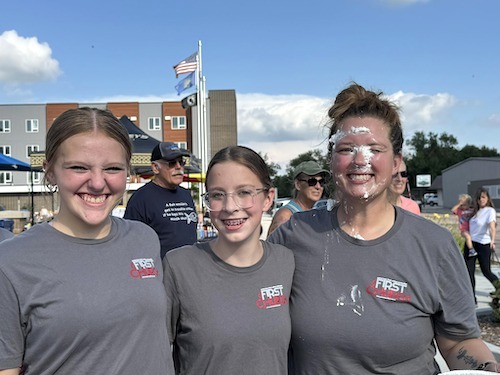
Pastor Kim (right) took pie in the face to raise money for the Watertown First UMC diaper mission.
Like any shared appointment, there are challenges. Sara named travel time, weather concerns, and the adjustment from a full-time associate role to a part-time arrangement as ongoing realities. Still, she remains hopeful.
“My advice to churches considering something new is to take time to pray about what is right for your church and what is possible,” Sara said. “God might do something new.”
As Clark UMC and Watertown First UMC continue this partnership, their story offers encouragement to other congregations navigating change—reminding United Methodists across the connection that faithful ministry is not about doing everything the way it has always been done, but about listening, adapting, and trusting God to work in new and creative ways.